
Lancaster County Previous Resident Sources
A backward address trail uses several record types because each answers a different question. A deed records transfer parties and a legal description. A directory gives a printed address association on its publication date. A census adds a dated household. None alone is a complete list of everyone who lived at a property or proof that a listed person owned it. Start with the era that fits the question, retain the source for every statement, and let gaps remain visible until another record can test them.
| Source | Years It Covers | Where Held | What It Shows |
|---|---|---|---|
| Deed records | 1729–present | Recorder of Deeds and County Archives | Transfer parties, legal description, book or page, and dates |
| Online historic deed index | 1729–1980 | Recorder Infodex and County Archives | Grantor or grantee lookup and document reference |
| Unrecorded Deed Index | 1735–1985 | County Archives | A delayed or missing transfer clue |
| Sheriff deed and mortgage indexes | 1825–1905; 1807–1981 | County Archives | Forced-sale or finance events tied to a property |
| City and County directories | 1843–1922 digitized run | LancasterHistory and POWER Library | Printed address, business, or occupation association |
| Census microfilm | 1790–1930 | Lancaster Public Library | Released household and person context |
| Sanborn maps | 1912–1950 | Library of Congress and LancasterHistory | Building, block, street, and change evidence |
For a modern parcel, begin with the assessment and map reference, then use the Recorder trail. For a nineteenth- or early-twentieth-century question, test the deed trail against a directory edition and the nearest released census. Lancaster County previous residents should be described with the record role attached: recorded grantee, directory listing, enumerated household, or probate party.
Lancaster County Deed Index Paths
Lancaster County Recorder of Deeds Public Records Search is the current portal for recorded instruments after its disclaimer. It belongs near the start of a house-history trail, but the deed reference and legal description matter more than a familiar street number. Historic deeds begin in 1729. The County’s historical Infodex reaches through 1980 and describes grantor or grantee, deed-book reference, deed and recording dates, property location, and the book or page path to an image.
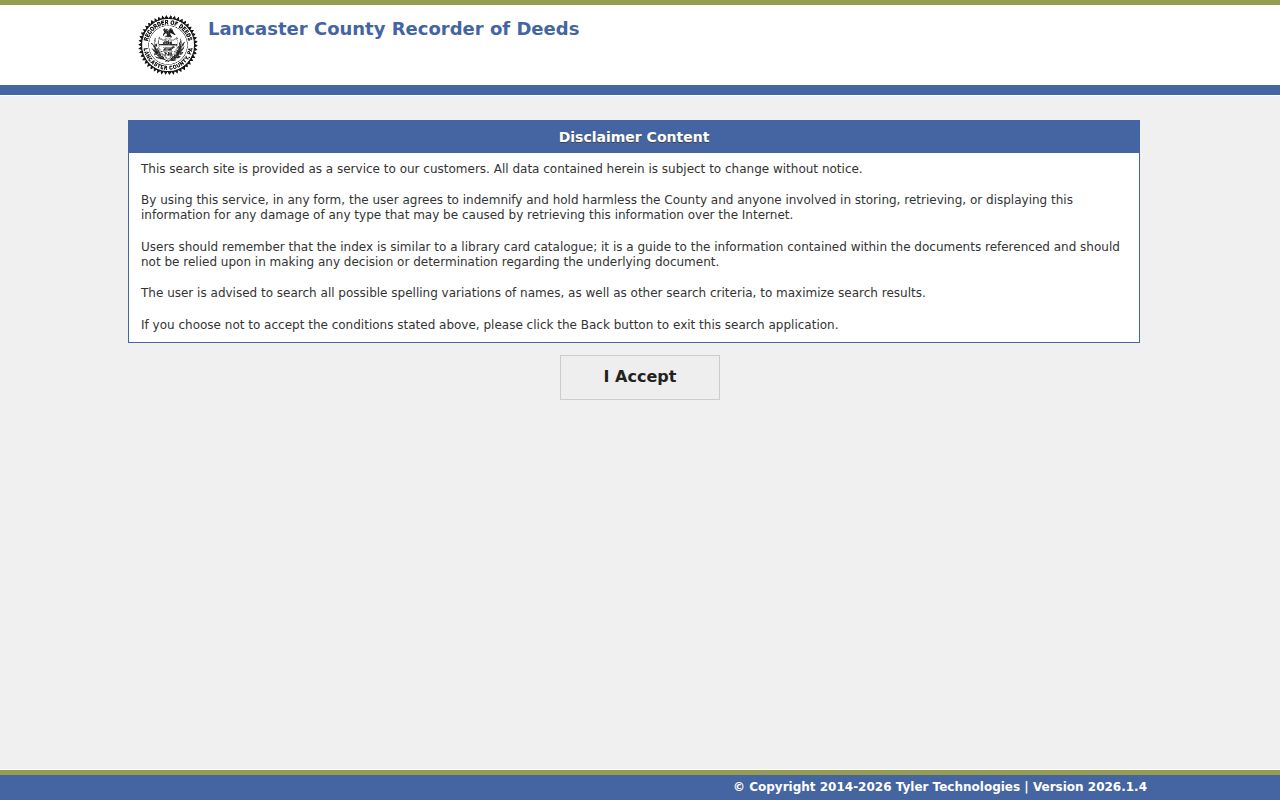
The public-search entry point leads to the current Recorder route. Keep the portal URL and the date searched in the research notes because current Tyler workflows and older Infodex procedures are both part of the local record trail.
For historic work, use Search Records as Guest, then Search by Name and the appropriate volume or year range. Select the party role, enter surname before first name, and check spelling variants. Recording can lag execution, so a search should cover more than one likely range. Go To Document opens an image by book letter or volume and page for printing or download.
Lancaster County Map Continuity
Address continuity must be tested before a historic directory line is joined to a present parcel. The County historic map viewer overlays current parcels and roads on warrant-era maps and mapping from 1824, 1864, 1875, and 1899. LancasterHistory adds warrant, County, City, and Sanborn map collections. The Sanborn material identified for Lancaster County spans 1912–1950 across 129 sheets. It can show a building’s footprint, material, and use, but it does not name the full household.
Lancaster County Historical Indexes provides the documented entry route for the historical-map workflow. Use the map to compare road alignment and tract context, then let the deed’s legal description control the land match.
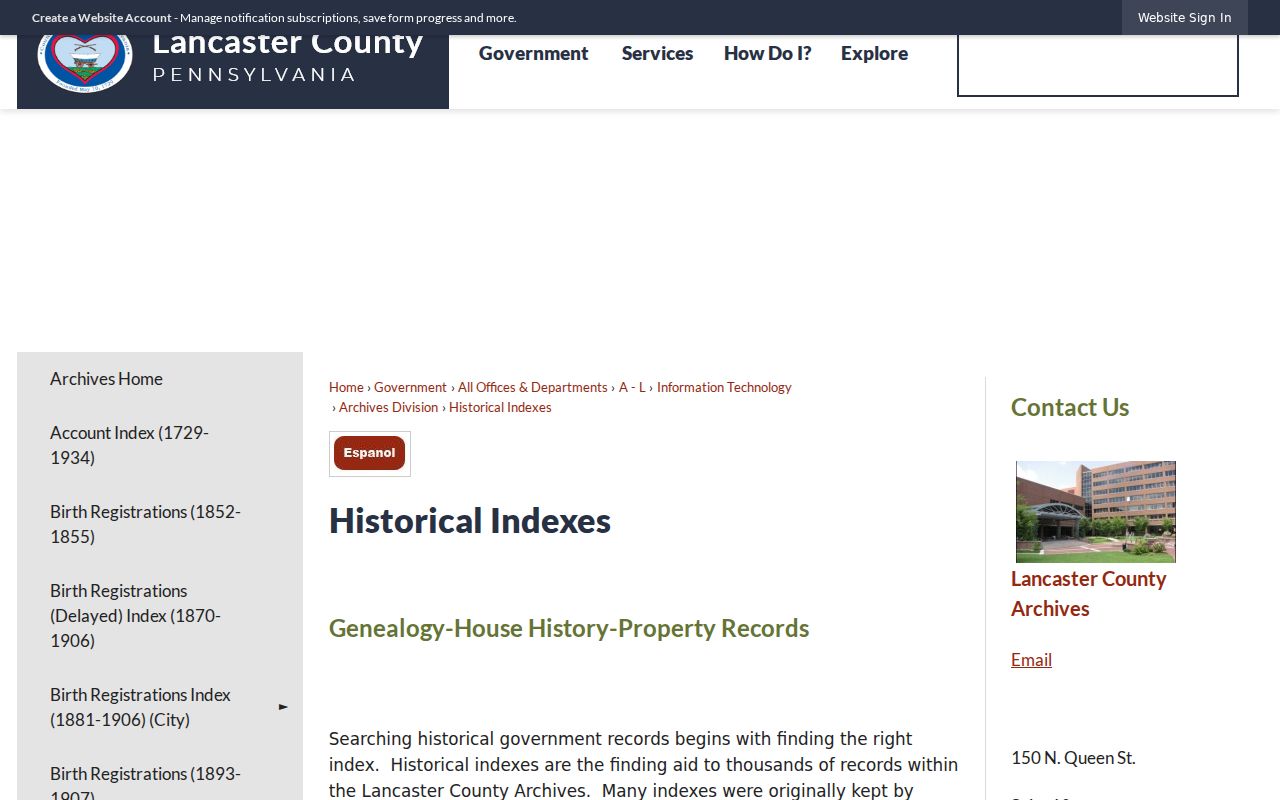
The historical-index page supports a map-first check when a number, road, or parcel appears to change across records. A Countywide renumbering chronology was not located, so a mismatch remains a reconciliation problem rather than an assumed continuous address.
Tracing Lancaster County Deed Chains
The backward deed process starts with a present parcel, not a surname. The Lancaster County Property Tax Inquiry can search an owner name, address, or parcel or account number. Its card distinguishes a situs address from owner mailing or correspondence information, and neither field proves that a person currently lives at the site. Use the parcel number and LanCo View’s deed-reference context to select the right recorded instrument before walking backward.
- Copy the current parcel or account number, situs address, displayed owner-of-record label, and date queried from the assessment record.
- Use the parcel and map context to preserve the deed reference and municipality, especially on a long or similarly named road.
- Open the current acquisition instrument through the Recorder and record grantor, grantee, deed date, recording date, book or page, and legal description.
- Search the seller as a grantee to locate that party’s earlier acquisition, then compare the legal description before accepting the handoff.
- Repeat the seller-to-prior-grantee step only when the lot, subdivision, tract, metes-and-bounds call, or book-page chain supports the match.
- Label every result by its role, such as recorded grantee or document party, rather than calling every name a resident.
A legal description may name a lot and block, subdivision, tract, metes-and-bounds description, or deed-book reference. It is often more stable than an address, particularly where parcels were split, merged, or carried an older rural-route description.
- Grantor and grantee
- The grantor transfers an interest in the instrument; the grantee receives it. Their names document the transaction, not every person at the address.
- Chain of title
- A documented sequence of conveyances for the same land, tested by legal-description and document-reference matches.
- Legal description
- The recorded description of land, such as a lot, tract, subdivision, or metes-and-bounds call, used to keep the trail on the same property.
Lancaster County Index Gaps
When a link in the chain appears to break, do not conclude that no transfer occurred. The County house-history guidance directs searchers to inspect later index ranges and the Unrecorded Deed Index because recording can follow execution after a delay. Test alternate spellings and party roles. Then consider the sheriff deed index, mortgage index, estate sale, subdivision or plan reference, and any relevant municipal permit record. Each may describe an event connected to the place without establishing day-to-day occupancy.
The County Archives holds unrecorded deeds for 1735–1985, sheriff deeds for 1825–1905, and mortgages for 1807–1981. These precise index epochs can help date a transfer, forced sale, or finance event. They should not be merged into one unsupported story about past residents. Keep unresolved alternatives in the notes when an image, description, or date does not align.
Note: A late recording date may point to a transfer event without identifying the date when anyone moved.
Lancaster County Past Households
Ownership is only one layer of an address history. The 1843–1922 digitized directory run can supply a printed address, occupation or business clue, and occasional spouse or widow notation for a particular edition. A street or criss-cross section exists only in editions that include one. It is an address-to-occupant association, not proof of title or a complete household roster. The collection details and reading method remain on the Lancaster County Directory Book.
For previous residents, transcribe the edition year, page image, initials, punctuation, address, and all relevant abbreviations. Next, compare the closest directory years for a changed street, trade, or spouse clue. A printed association gains weight only when it is consistent with the parcel, map, census, estate, or newspaper record for the same period.
Address chain: parcel and deed reference → legal description → directory edition → released census household → estate or obituary context.
Lancaster County Census Pairing
Lancaster Public Library’s Local History collection provides federal-census microfilm from 1790 through 1930, plus city directories, selected newspapers, local histories, atlases, and yearbooks. Pair the directory period with the nearest released census to separate people with the same name and to test household composition. A boarder, adult child, or listed business proprietor may have a different connection to the property than the owner named in a deed.
- Choose the directory edition closest to the address question and copy its full printed line.
- Locate the nearest released census year in the Library’s microfilm range.
- Compare names, ages, household arrangement, street information, and timing before drawing a conclusion.
- Use a newspaper, death affidavit, estate file, or obituary as a dated check when a person disappears from the directory.
County Archives holdings offer wills from 1730, intestates from 1753, estate files from 1902, inventories, accounts, death affidavits, and related material. Those records can corroborate a dated family event, but an inventory or probate party is not a resident list.
Lancaster County Archive Requests
Lancaster County Archives is the offline route when an index produces a useful reference without an online image. The research room is in the Government Center basement or suite 10 and is open weekdays from 8:30 a.m. to 5:00 p.m., with no pulls after 4:45. Register, use the public indexes, and request retrieval. Staff will check a stated indexed timeframe but do not conduct broad, open-ended research.
Email archives@lancastercountypa.gov or send a mail request with prepayment. Electronic copies cost $5 for up to 20 images or pages and $0.50 for each additional image or page. Give a name, date range, record type, series or book-page reference, and the particular address or parcel connection. Fragile material may not be available. That level of detail lets the Archives place a focused request in the right series.
Lancaster County Lawful House History
House and family history research is most reliable when it stays tied to a dated document or published source. Pennsylvania’s Address Confidentiality Program can provide a substitute address in voter, court, vehicle, school, marriage, and other government records for eligible participants. A missing address or conflicting field may therefore reflect a protected record, not a reason to infer a person’s location.
Keep the distinction between owner, document party, directory listing, and enumerated household visible throughout the work. It protects the accuracy of a house history and respects the people whose information appears in public records.